Engineering Review Architecture & Systematic Decision Frameworks
ReviewWindow Fieldbook is an open engineering resource built to transform informal, unstructured technical walkthroughs into rigorous, multi-perspective evaluation windows. We formulate structured criteria for evaluating mission-critical systems across hardware, firmware, manufacturing, and operational lifecycles.
In complex engineering initiatives, teams often conflate branching design options with disciplined stage-gate evaluation. Our field manual provides standardized protocols, role-specific inquiry checklists, and audit frameworks that give cross-functional teams clarity before manufacturing commits and physical tooling begin.
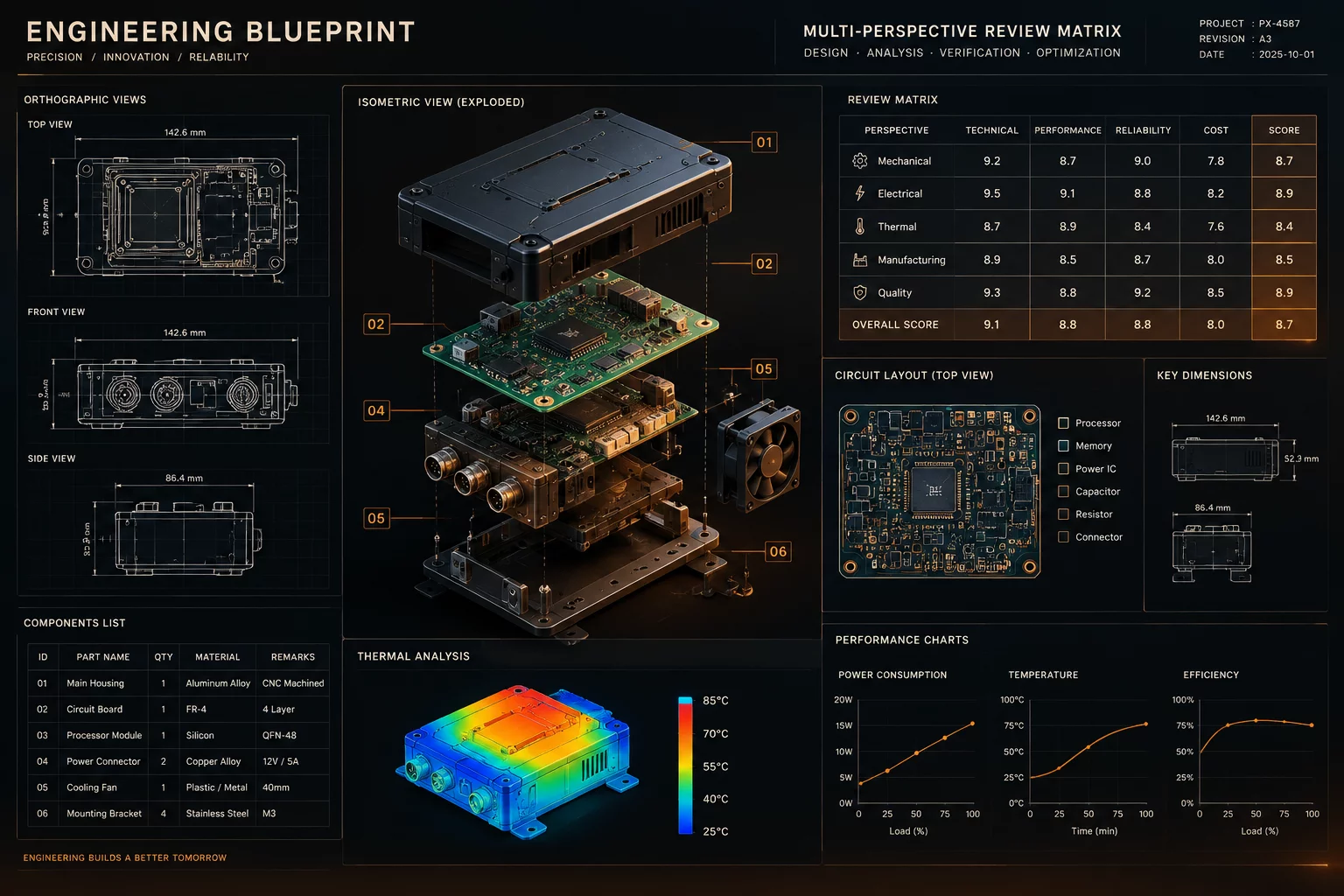
Multidisciplinary evaluation window model for engineering governance.
Core Distinction: OptionFork vs. ReviewWindow
Understanding the dual instruments that govern high-reliability engineering evaluations.
OptionFork: Alternative Space Exploration
OptionFork isolates and models distinct architectural branches, topology variants, and material selections before consensus is required. It answers the fundamental question: Which alternative paths are viable under known project constraints?
- Parametric trade-off comparisons across power, mass, and BOM cost
- Sensitivity analysis for alternative supplier ecosystems
- Risk scoring across conflicting technical constraints
ReviewWindow: Disciplined Gate Synthesis
ReviewWindow establishes structured, bounded perspectives (Thermal, DFM, Assembly, Operations, Regulatory) through which a selected design must pass. It answers: Has this chosen baseline been rigorously audited from every operational vantage point?
- Role-bounded inquiry checklists with mandatory sign-off criteria
- Assembly tolerance stack and manufacturing tooling verification
- Actionable defect register with trace-forward ownership
The Five Engineering Evaluation Windows
Every technical proposal undergoes scrutiny through five structured, role-specific observational windows.
Structural & System Integration
Thermal dissipation pathways, mechanical stress tolerances, interconnect clearance, and spatial envelope integrity under peak environmental loads.
Design for Manufacturing (DFM)
Tooling clearances, yield sensitivity, raw material lead-time vulnerabilities, process repeatability, and tier-1 vendor fabrication bounds.
Assembly & Serviceability (DFA)
Fastener access channels, poke-yoke alignment features, harness routing fatigue zones, and subassembly swap timelines during field maintenance.
Operational Reliability & Diagnostics
Telemetry sensor coverage, single-point failure containment, degradation telemetry indicators, and firmware boot recovery margins in degraded states.
Stakeholder & Compliance Audit
Certifications alignment (EMC, CE, UL), lifecycle component obsolescence roadmaps, warranty cost containment, and end-of-life recycling requirements.